


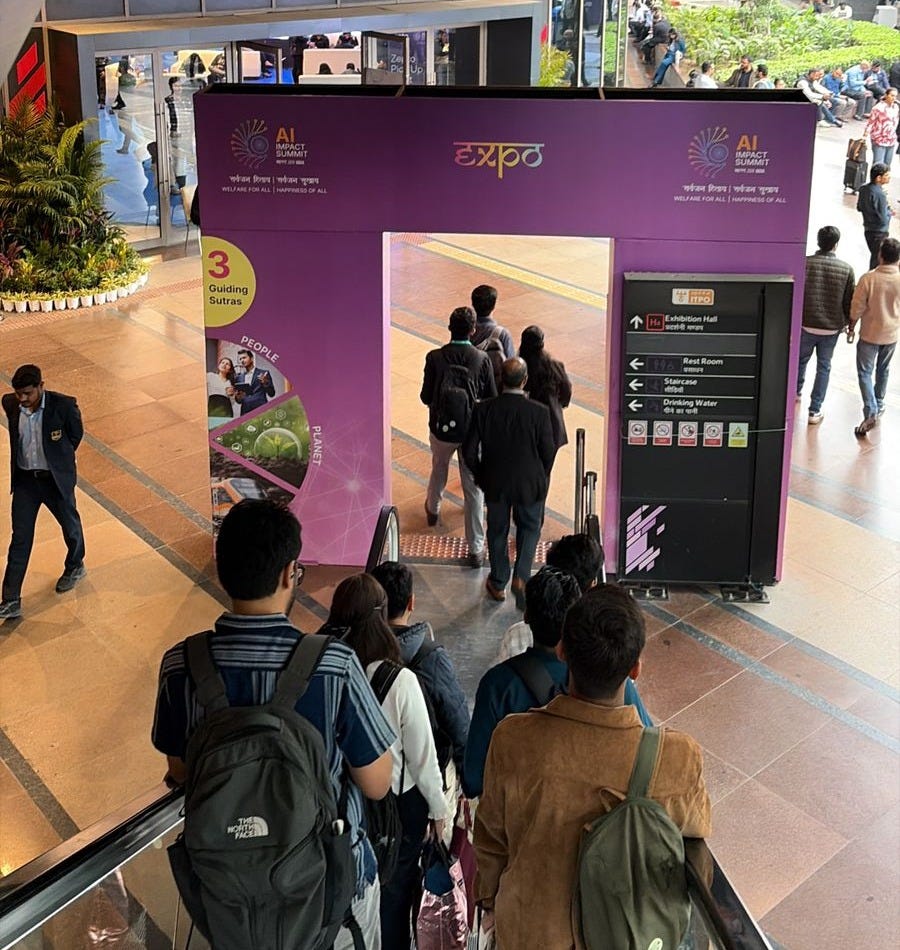
On what should’ve been a 7 minute ride to the India AI Summit, Delhi’s traffic was doing its best impression of permanence. My cab driver watched the brake lights ahead and asked, “Is there some big AI event today? Everyone is talking about it.” He had questions, and traffic gave us time. “What exactly is AI?” he asked. “Can it drive a car? I’ve heard it can, in China. And can it talk to passengers? Because people like to talk.” We moved forward, paused and then moved again. The navigation voice insisted this was the fastest route. He raised an eyebrow at the screen the way someone might regard their permanently confident but occasionally wrong friend.
Technology, to him, was useful when it worked and a story when it didn’t. He liked that payments were easy now and he liked that maps helped. But he also trusted what he had learned from years on the road, like which turn behaves differently after 6 pm and which signal negotiates with time. Just before I got down, he said, “If AI is going to take my job, let me see it fix my road and traffic first.”
It felt like a perfectly reasonable ask. For everyday people, the question around AI is rarely about an abstract worry, it is about how it will interact with them tangibly. Will it make ordinary life smoother to live in?
We celebrate artificial intelligence for speed and accuracy. But the qualities people notice, and want most, are something else entirely. They want things like relevance and usefulness that meets the situation they are actually in.
We see this tension often in law and justice. Systems can process documents faster, surface precedents in seconds, and as of Sarvam’s launch on Day 3 of the summit, they are getting remarkably good at OCR (Optical Character Recognition: that turns an image into text), even retaining the formats of original documents. Yet the question people bring to a legal system is never only technical. When someone asks how to obtain their much delayed father’s death certificate to apply for a ration card, they are not asking for information in the abstract. Sending them to an office that used to exist but shut down two years ago is technically an answer, but not of any help. An outcome that is fast but distant does not feel like resolution.
This is where intelligence becomes a collective act. It lives in the lawyer who knows how a particular office functions on a particular day. It lives in the civil society organisation that can connect someone to a local official who will actually respond. It lives in the frontline justice worker who knows which step matters first and which one can wait. These forms of knowledge are practical, situated, and deeply human.
This cab ride was not a debate about the future. It was a glimpse of how people are meeting it - if intelligence is going to surround us, the hope is simple. Let it be measured by usefulness, not abstract brilliance.
And if it can manage traffic snarls, even better.
Misaal in Punjabi and Urdu means role model, exemplar or shining light. M.I.S.A.A.L - the Multi-dimensional Intelligence Standard for Assessment of socio-Legal AI Interactions is an effort to hear from thousands of users inside diverse communities to surface the elements that truly represent a quality AI response to a query pertaining to law or justice.
