


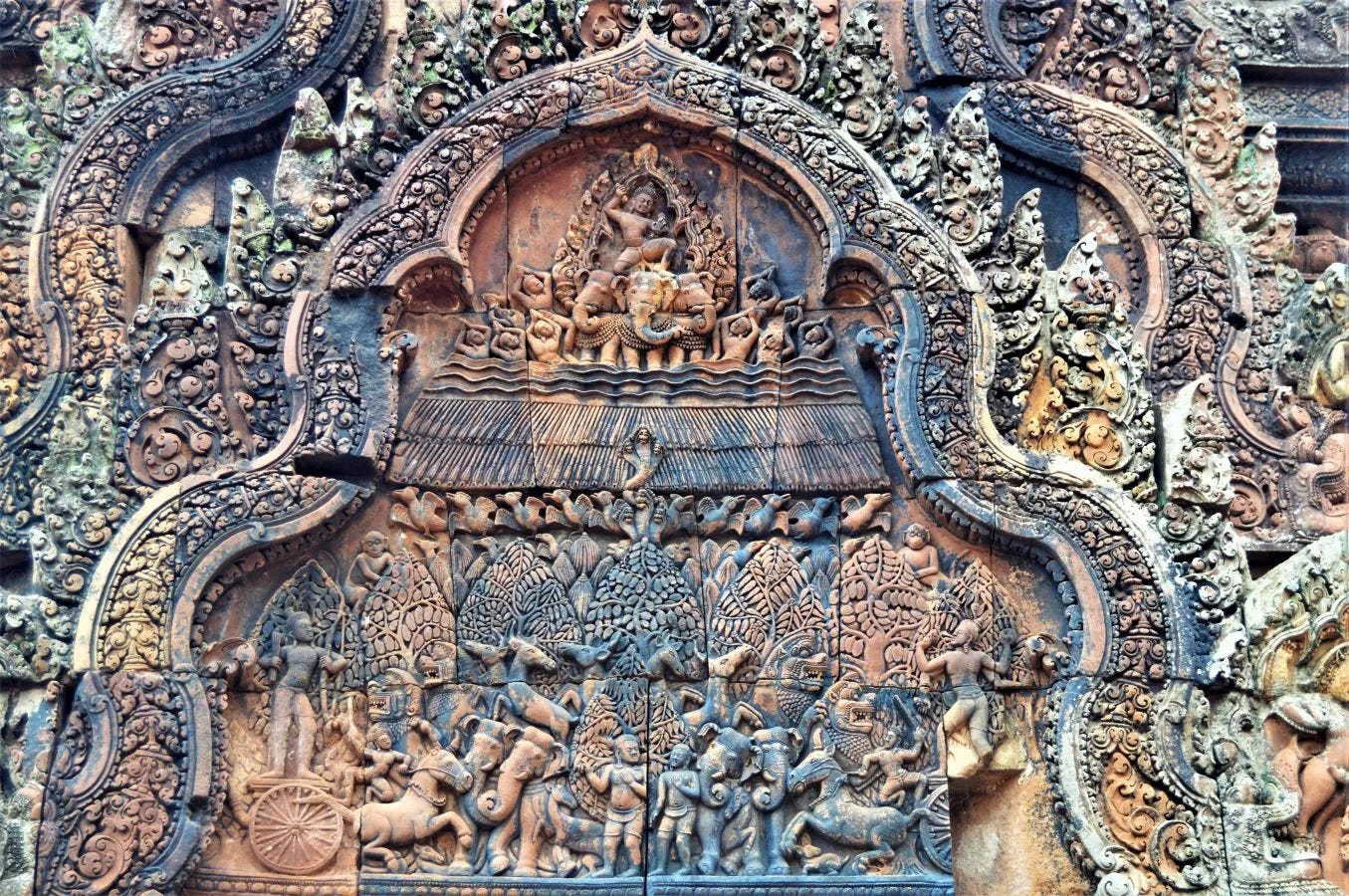
This carving is a thousand years old and comes from Banteay Srei temple in Cambodia. It depicts the burning of Khandava forest, a scene that travelled far from its origins in the Sanskrit epic. The fire described in the text still holds its place in this stone relief.
Some years ago, I embarked on a deep reading of the Mahabharata - a daily discipline of reading, digesting, and wrestling with its sprawling verses of the Mahabharata. I was looking for an unadorned philosophy of everyday life, a “street metaphysics” of sorts, dragging Indian philosophy out of the sterile halls of universities and the rigid dogma of fundamentalists. Not unlike the forest communities in which the exiled Pandavas argued about life, the universe and everything else. I wanted a philosophy that could breathe the polluted air of our modern world and help make sense of its dizzying complexities.
If you ask the average person what the Mahabharata (or the Jaya, as it is originally known) is about, they will tell you it is the ultimate family drama. It is a chronicle of a fratricidal war, a bloody dispute between two warring clans, the Pandavas and the Kauravas, over a kingdom. It is also a chronicle of divine weapons and the wisdom of elders, elements that continue to influence popular culture and many discourses of Indian life. And they wouldn’t be wrong. It is a magnificent, terrifying exploration of human dharma: the ethics of statecraft, the limits of patience, the justification of revenge, and the terrible burden of duty.
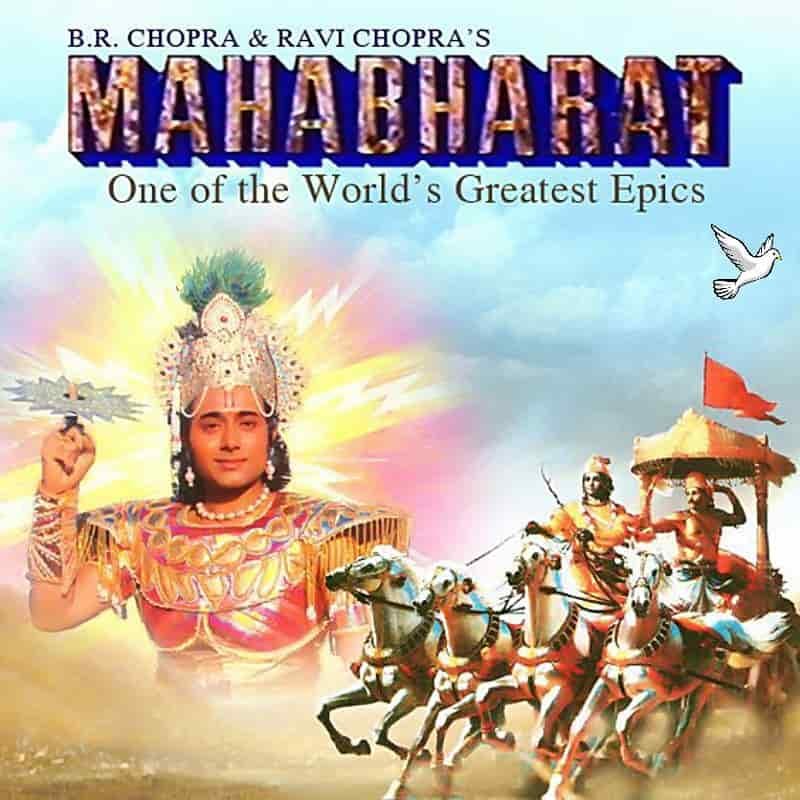
Mahabharata has a public afterlife that remains vivid even today.
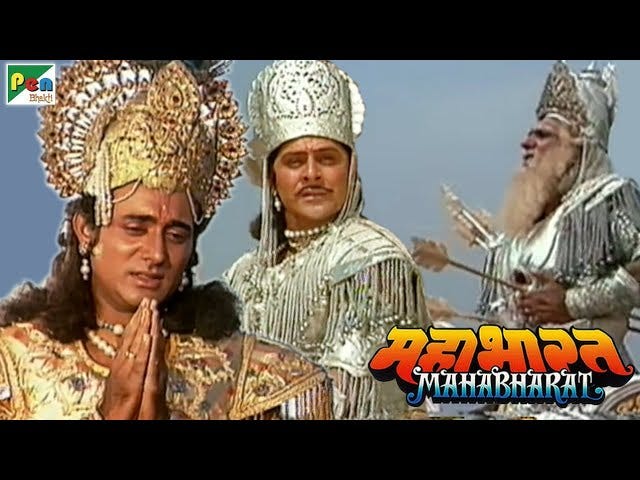
Long before web series and cinematic universes, the Mahabharata was India’s original blockbuster. These posters are from television series that shaped how many generations pictured Krishna and the Pandavas.
But the drama is more than human isn’t it? It contains a full entourage of living creatures, both mortal and immortal. As I wandered through this vast, hypertextual landscape of stories within stories, I realised that much of it was also shaped by the profound, often violent encounter between humanity and the non-human world. After all, the epic is recited at its beginning, on the occasion of a snake sacrifice (the Sarpasatra), which is stopped before it causes extinction. To understand dharma, the central, elusive obsession of the epic, we have to look beyond the battlefield of Kurukshetra. We have to look at the forests, the animals, the rivers, the gods, and the unstoppable force of Time.
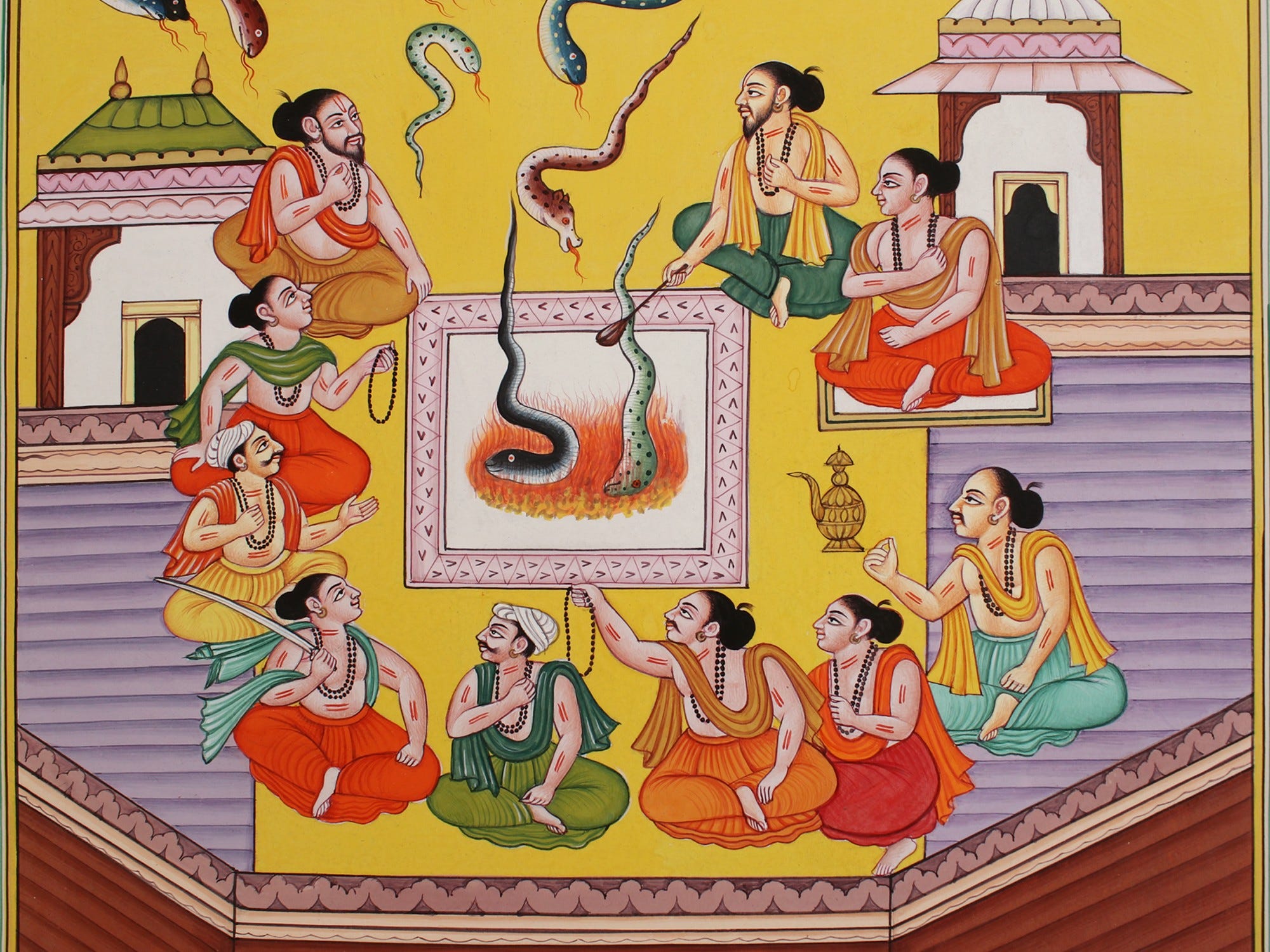
The snake sacrifice turns grief into exterminatory rage. In this scene, the epic opens with a chilling question about vengeance and power, and also the ease with which an entire species can be made into an enemy.
Itihasa and the Halls of Justice
In the Itihasa, the world is alive, a massive, pulsing democracy of sentience. The Jaya houses beings of many kinds. It is a cosmos teeming with gods (Devas), demons (Rakshasas and Danavas), rishis, speaking swans, vengeful snakes, and celestial nymphs. Here, the non-human has a voice, and in the itihasic imagination, to speak is to be admitted into the halls of justice. To speak, then, is to hold citizenship in a commonwealth that reaches from the earth to the cosmos. Here, the Jaya offers an imaginative precursor to attempts such as Project CETI and the Earth Species Project that are building technologies to communicate with other species.
The boundaries between the human and the non-human in the epic are remarkably porous. The supernatural doesn’t reside in some distant, absentee heaven; it walks the earth. Gods intervene in human affairs, hold petty grudges, and engage in existential struggles. Animals are not background scenery; instead, they are karmic actors. When King Nala is abandoned and desperate, it is a golden swan that serves as his messenger, setting the wheels of his destiny in motion. The epic continually insists on exploring the dharma of every being. Just as a king has a duty to rule, a tiger has a duty to hunt, and fire has a duty to burn. Dharma, as the epic never ceases to remind us, is subtle and profound; it is the intrinsic nature of a being, and the catastrophic conflicts of the epic usually occur when the dharmas of different species collide. It’s in the nature of the snake to bite and the king to hunt and the deer to frolic, but there’s something wrong when the king imposes his violence upon others without restraint.
To speak, then, is to hold citizenship in a commonwealth that reaches from the earth to the cosmos.
In one of the many interludes in the Mahabharata, Dushyanta (the father of Bharata and Shakuntala’s husband) arrives at the Rishi Kanva’s ashram in pursuit of a deer and is asked not to release his arrow. Dushyanta lowers his bow and meets Shakuntala soon after; meanwhile, his descendant much removed - Pandu - can’t restrain himself and the arrow he releases into Kindama’s heart is a precipitating incident for the epic. We can’t all be ascetics, but unrestrained greed is often a cause of catastrophic violence.
Nowhere is this collision more tragic, or more relevant to our modern ecological crisis, than in the foundational acts of violence that bracket the epic.
The Bookends of Ecocide
If you want an itihasic perspective on the modern world, in an age of climate catastrophe and mass extinction driven by unchecked developmentalism, you must look at how the Mahabharata frames the building of human empires. The epic bookends the apocalyptic human violence of the Kurukshetra war with two massive, calculated genocides against the non-human world.
The first is the framing narrative of the entire epic: the Sarpasatra, or the great Snake Sacrifice.
The story begins with King Parikshit, the grandson of the great hero Arjuna. While hunting in the forest, Parikshit grows thirsty and asks a meditating sage for water. When the sage, deep in a trance, does not answer, the arrogant king picks up a dead snake with the tip of his bow and drapes it around the sage’s neck. It is a casual, thoughtless desecration of both the spiritual and the natural world. Parikshit is subsequently cursed to die by the bite of Takshaka, the king of snakes.
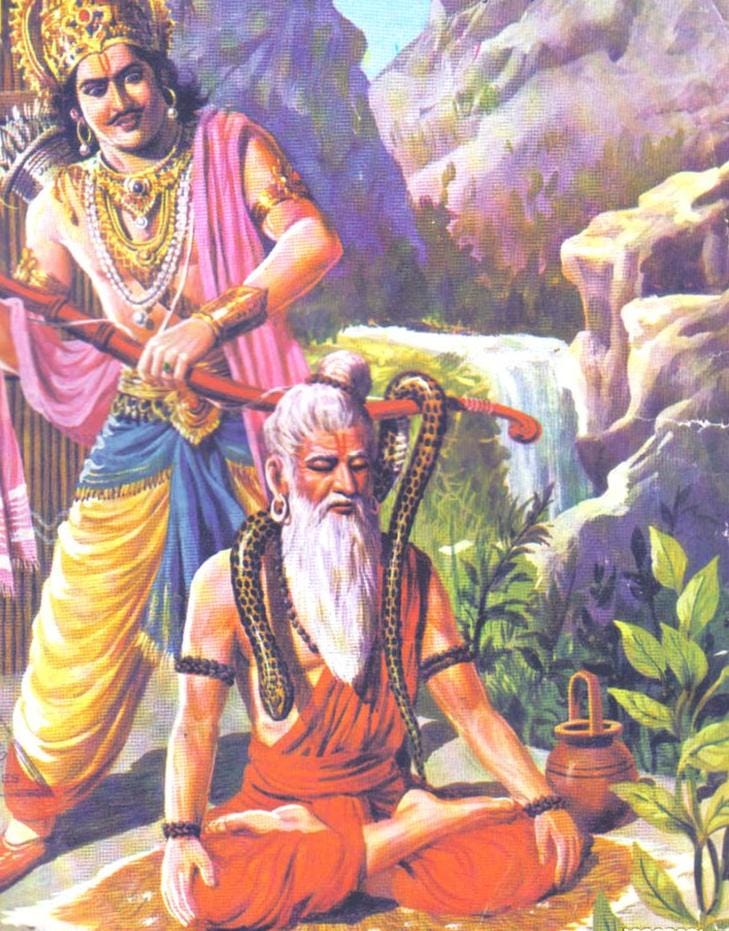
A thoughtless insult, a dead snake draped in mockery and a chain of consequence that outlives the king who set it in motion. Small cruelties rarely stay small.
When Parikshit’s son, Janamejaya, ascends the throne and learns of his father’s death, he does not seek justice against a single serpent. He seeks total annihilation. He organizes a massive sacrifice with the express purpose of magically drawing every snake in the world into a blazing fire. It is an act of species-wide revenge. As I read this, I couldn’t help but think of our modern grudges. What is it with men in power and their thirst for disproportionate vengeance? We see an act of terror, and we bomb entire nations. Janamejaya’s snake sacrifice is the ancient blueprint for our modern wars of extermination. It is the hubris of a human king deciding that an entire species must be wiped off the face of the earth to satisfy his grief.
But the epic does not let this genocide stand. The sacrifice is interrupted by Astika, a young scholar born of a human father and a snake mother. Astika is the ultimate bridge between species, an activist-shaman, stepping in front of the flames to negotiate peace. The Mahabharata is recited to Janamejaya during this very sacrifice, serving as a desperate, sprawling plea for empathy.
The epic itself is the medicine meant to cure the king of his genocidal rage.
The Inferno of Progress: The Burning of Khandava
If the Snake Sacrifice is the bookend of the epic, the Burning of the Khandava Forest is its dark, foundational heart. Before the Pandavas can ascend to imperial glory, they need a capital. They are given a tract of wild, untamed land: the Khandava forest. But they do not simply chop down trees to build their gleaming city of Indraprastha. They burn the forest to the ground in an act of staggering ecological violence, in which they are aided by Agni, the god of fire. Evolutionarily, humans became humans in part because we tamed fire; ever since, Agni is the motive force behind human civilisation, the Promethean gift that protects us from predation and allows us to forge tools.
But Agni is also an insatiable hunger. Having been overfed by King Swetaki in a twelve year long sacrifice, Agni’s indigestion can only be cured by devouring a forest’s worth of creatures. He approaches Arjuna and Krishna and begs them to help him consume the Khandava forest, which is protected by the rain god, Indra. As Agni engulfs the ancient forest, thousands of animals, birds, and forest-dwelling creatures rush to the edges to escape the inferno. And there stand the great human heroes, Arjuna and Krishna, shooting arrows into any creature that tries to flee, forcing them back into the flames. They slaughter elephants, lions, deer, and birds. They burn the forest down to its roots to feed Agni’s hunger and to clear the land for their empire. Indraprastha, the greatest city the world had ever seen, was built on the ashes of trees and snakes.
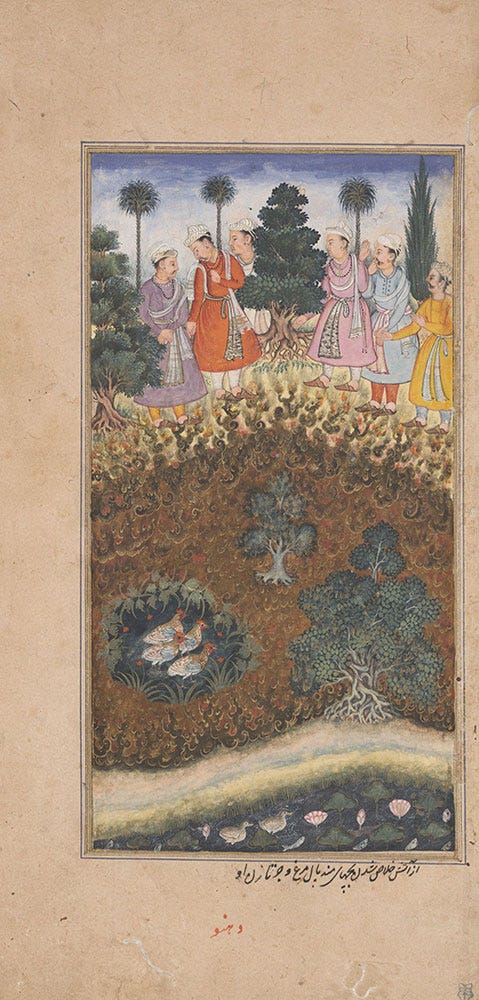
Even in a landscape marked by destruction, some lives endure and carry the future forward. Survival here is fragile; it is collective. The sarngaka birds ask us what collaborative survival looks like when the world around them is ending.
When we look at the Amazon burning today to make way for cattle ranches, or when we look at the blackened skies of our industrial capitals, we are looking at Khandavaprastha. The Mahabharata understands the terrifying double-edged sword of human progress. Civilisation requires the taming of fire, yes; both sword and brick are its progeny. But take it too far, and we run the risk of collapse. The Pandavas established their supremacy through violence against nature. Should it surprise us that this ‘original sin’ culminated in absolute violence against their own kin?
The Limits of Human Dominion
Yet, the Mahabharata is not a text of unyielding despair; it is a text of deep philosophical inquiry, a street metaphysics of dharma. It constantly questions the limits of human dominion. Does a warrior’s dharma justify unchecked violence against the non-human? Consider the story of King Pandu, the father of the Pandavas. While hunting in the forest, Pandu spots a male deer mating with a doe. Without hesitation, he draws his bow and shoots the male deer.
But this is the itihasa, where the boundaries blur. The deer is not just a beast; he is a powerful Rishi (sage) named Kindama, who had taken the form of a deer to enjoy the pleasures of the forest away from human eyes. As the sage lies dying, he rebukes the king. Pandu defends himself using the logic of human supremacy. He argues that the dharma of a Kshatriya (a warrior) allows him to hunt wild beasts by any means necessary - openly or by stealth. A king rules the forest, Pandu argues; therefore, the forest’s lives are his to take. The dying sage dismisses this anthropocentric arrogance. He does not dispute the king’s right to hunt for food, but he condemns the king for shooting a creature in the sacred act of mating. He curses Pandu: if the king ever approaches his own wives with desire, he will die instantly.
Even a king’s violence against nature has limits. The forest has its own rhythms, its own sacredness, its own dharma that exists independently of human needs. When human law violently disregards the natural law, the earth strikes back. The curse of the dying deer sets the entire tragedy of the Mahabharata in motion, rendering Pandu unable to father children normally and leading directly to the birth of the rival clans.
Time, Chance, and the Cosmic Joke
Finally, the non-human enters the Jaya as an unstoppable cosmic force: Time, or Kala.
Throughout the epic, human beings scheme, debate, and fight. Yudhisthira obsesses over rule-following. Draupadi and Bhima argue passionately for pragmatic action, political reality, and justified anger. They build empires, they lose them in rigged games of dice, they spend years in exile wandering the forests - which, crucially, act as the ultimate school of dharma, stripping the royals of their hubris.
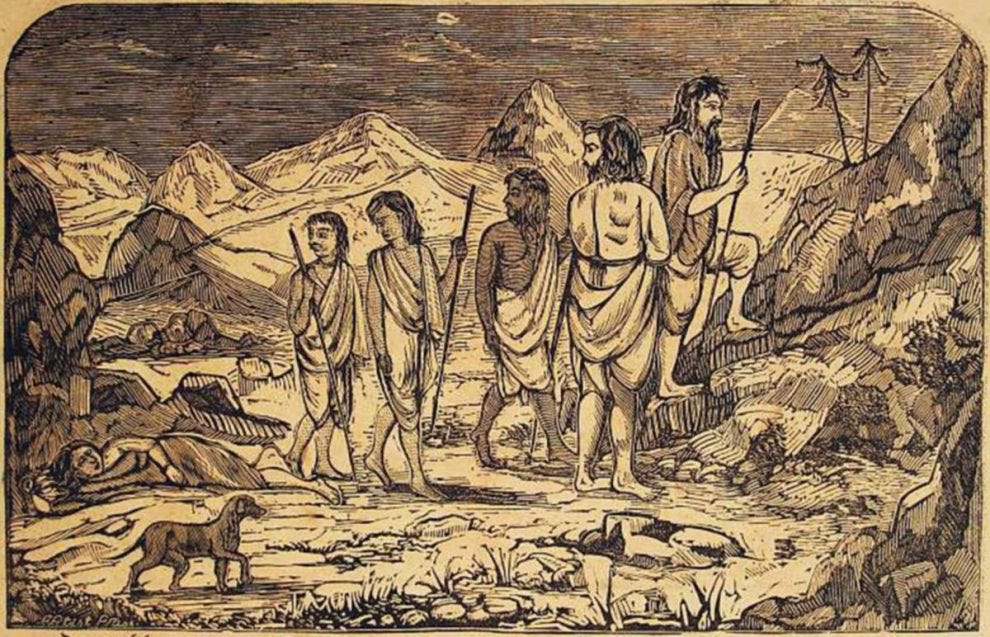
At the end of the epic, the dog walks beside the Pandavas as a figure of loyalty and dharma.
But looming over all their human debates is Kala. Time is not a passive ticking clock in the Mahabharata; it is an active, non-human entity that routinely possesses individuals and ravages empires. Time is the ultimate equaliser. Regardless of how ruthlessly kings subjugate the earth, how many forests they burn, or how profoundly they debate their human dharma, they are subject to the cosmic cycles of boom and bust. The Mahabharata ends not with a triumphant parade, but with the heroes walking into the Himalayas, dropping dead one by one, their glorious empire already fading into the dust.
A Street Metaphysics for a Burning World
To recite the Jaya today is to recognise that we are living in the ashes of Khandavaprastha. We have built a magnificent, terrifying world of glass and steel, but we have done so by declaring war on the democracy of sentience. Our modern Rajdharma of economic and political duty has become fatally divorced from the non-human world. We treat the earth as a resource, the animals as products, and the climate as an externality. Perhaps street metaphysics can help reconnect us to the world around us, grounding our care in everyday acts of more than human justice. Justice today has to be planetary, and being so takes nothing away from justice towards the marginalised among our species.
But the Mahabharata warns us that dharma is a web. You cannot pull one thread without unravelling the whole. The violence we inflict upon the forests and the beasts will inevitably find its way into our homes, our cities, and our families. The profound, radical message of the Jaya is that our moral obligations do not end at the boundaries of human society. True dharma requires a reckoning with our dominion over the earth. The crisis before us is a result of our deep alienation from the planet and its various creatures, so much so that every butterfly and every bear is either a replaceable resource or a cute exhibit in a museum or zoo. We have lost the terror of being alive, the intense awareness of our mortality that sent the Buddha into the forest looking for the end of suffering. We have to end this alienation, starting with our senses. We have to listen to the voice of the swan, to respect the sacredness of the mating deer, and to recognise that we are just one species sharing a fragile, burning world.
And despite all these efforts, we too will eventually be swallowed by Time.
Rajesh is a mathematician and cognitive scientist by training and a philosopher by avocation, with a long-standing commitment to Indian philosophy as a form of street metaphysics. He has led multiple lives as an academic and as an entrepreneur, and in that second avatar, he leads Socratus, or as it is known, “the midwife of collective wisdom.” Over the past decade, his scientific, creative and political interests have all converged on one question: how do we grasp our terrestrial condition in a manner that enables a flourishing planet for all beings?
Socratus’ Substack, the Messenger, explores these questions further. His other writings can be found here.
Praani is our note on listening better to the voices of nature, ways of amplifying them, and finding pathways to bring them into our ways of governance. At Agami, we are deeply interested in how rivers, forests, animals, and even the winds and the stones might speak into our deliberations on justice.
