


Old systems can step aside to make room for new ones but they have to be pressured, inhabited, turned against their own habits. This edition of Praani takes three different routes into that. A staged courtroom hearing in Delhi where real lawyers and judges argue the rights of nature through the NGT’s own rules and processes, showing that the law is a powerful medium of change when used to its fullest potential. A forest burning in the Mahabharata, fifteen days long, narrated with such granular attention to who is lost and why that the epic itself becomes a kind of testimony. And a short reporting manual that asks whether the language of human–wildlife journalism can stop treating conflict as the only story worth telling. Each takes a form that already exists and asks what it would take to mould it toward something more honest.
How Far Can You Push a Tribunal?- ‘In the matter Re: Rights of Nature’
Khoj International Artists’ Association, with artist Zuleikha Chaudhari, staged a full-length National Green Tribunal hearing on air pollution and the rights of nature; using real lawyers, judges, and researchers, and following the exact procedures of the court. It’s worth watching in full:
I was initially skeptical of this performance because, at first glance, it looked and sounded almost indistinguishable from an actual court proceeding. Where, I wondered, was the rupture and the reimagining? The thing that would justify calling this a radical act rather than a faithful imitation? But the more I saw that it was trying to test how far the system itself could be made to move, the more heartened I got.
The advocates and judges in the play are real legal experts and professionals! The performers include Sr. Adv. Manmohan Lal Sarin, who was once Advocate General of Punjab, and three retired judges Justice Rajive Bhalla, Justice Kamaljit Singh Garewal, and Justice K Kannan. These were people very much “within” the system - indeed, as far as black-and-white conceptions of “the system” go, they were the system. And yet!
The witnesses, too, are actual scientists and researchers who inhabit these questions in their working lives. The hearing used the grammar of the NGT: the petition, the cross-examination, the evidence, the final order, and so on.
The hearing worked through the law, and in doing so showed that a case for the rights of nature can be made legible inside even the system’s own procedures, including by arguing that an anthropocentric reading of Article 21 is too small for the world it claims to protect. That the hearing did not have to bypass law in order to reach justice was heartening for the reason that we often find ourselves reaching for solutions that imagine the system has to be abandoned before anything better can be built. Solutions or pathways for something like a multispecies justice often either entirely circumvent the system or presuppose its destruction, and for good reason. However, here, was something just as difficult and interesting. This staged hearing was a demonstration that one can in fact stay inside the machinery, use its own language, and still force it to recognise that “humans are not owners of the earth but residents within it”.
I invite all the readers of this newsletter to watch this staged hearing to see how the structures of law and policy can be inhabited with such profound empathy that they transform into the very instruments of our liberation. In entirely good faith, maybe we can use the the tools and forms that we inherit, and realise multispecies justice as a functional possibility rather than a distant dream.
On Burning a World to Heal a God
Our second offering this time, is from the Mahabharata.
In the Mahabharata, the burning of the Khandava forest is a sustained, almost methodical act of ecological destruction. Agni, the fire god, is weakened after years of consuming excessive Ghee from sacrificial offerings and seeks cure by devouring the Khandava forest in its entirety to consume the “fat of those creatures” dwelling within. The hurdle he faces is that the forest is under Indra’s protection, because it houses the Naga chief Takshaka, the serpent king, his ally. Each time Agni attempts to burn it, Indra intervenes with torrential rain.
Agni then recruits Krishna and Arjuna, whose role is to prevent the rain, and prevent the escape of the creatures of Khandava. Animals run, clutching their young, birds are shot mid-flight, and water bodies boil until the fish and tortoises perish within them.
Only six beings survive the fifteen-day slaughter. Takshaka is absent at Kurukshetra, and his son Aswasena escapes through a moment of deception. Maya, the Asura architect, survives only because he seeks refuge with Arjuna and is spared because his skills are “useful” (he later builds the great Maya Sabha for the Pandavas).
If one reads this as a story of justice, it is not a comforting one. There is no universal principle governing who lives and who dies. Indra protects the forest only to save a friend; Krishna and Arjuna destroy it to fulfill an alliance with a god; and Maya is granted life because he can build for humans. In other words, no being is simply saved or simply destroyed; each fate is shaped by relationship and by the hierarchy of who is valued and who is not. Others that are unnamed, voiceless and unaligned are simply extinguished.
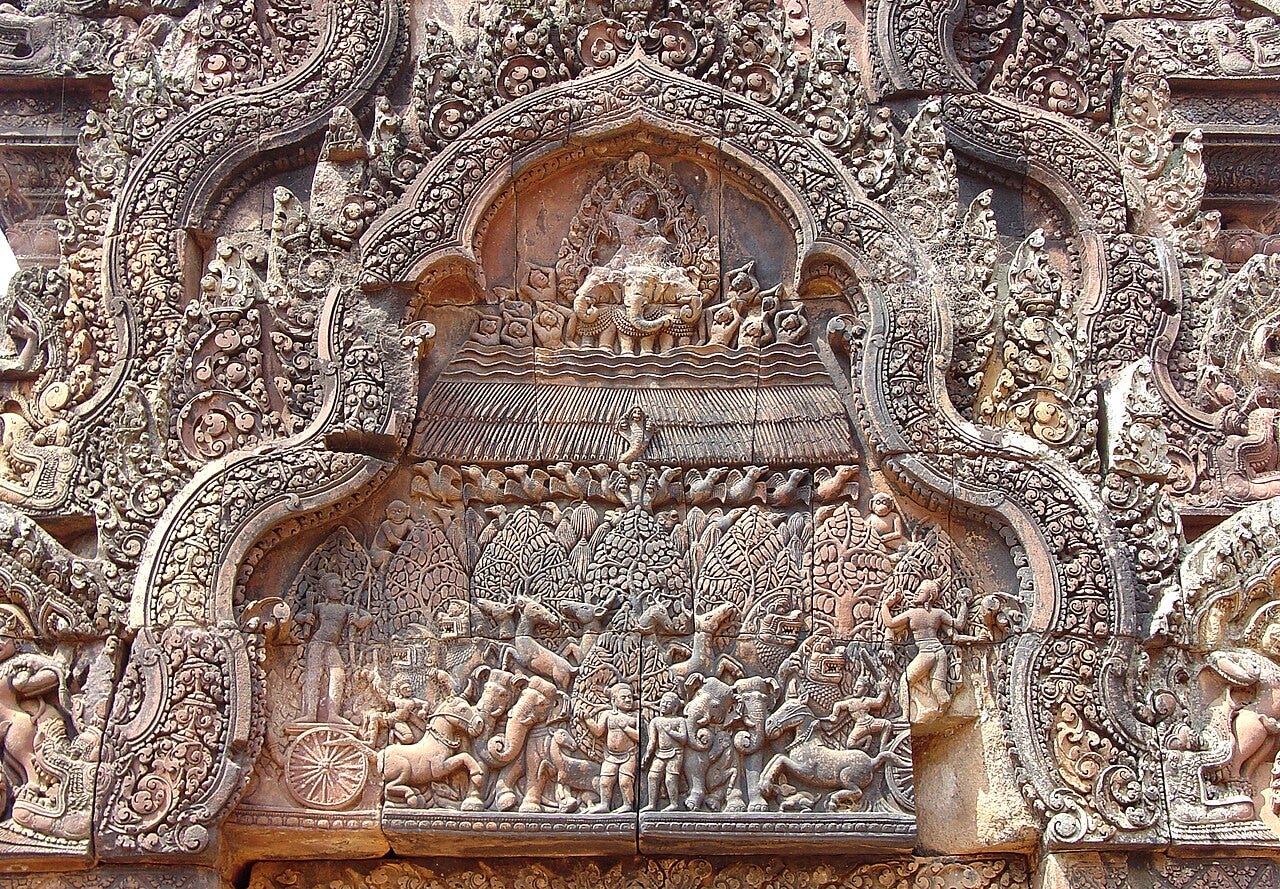
And yet, the narrative refuses to let us look away from the animal’s perspective. It describes the suffering in granular detail, recording the sounds and the attempts to escape, as well as the failure of those attempts. It documents the “frightful yells” and the “excess of affection” that leads creatures to die calmly because they cannot abandon their parents or children in the flames.
If there is a lesson here, it is not one about what justice ought to be, but an account of how it actually operates when it is entangled with power and relationship. The Khandava myth forces us to recognize that coexistence is often uneven, and often violent.
The forest burns so that something else may be built, but the flames will ever ask: who, exactly, gets to remain when a sacrifice is demanded?
Against the Easy Headline

Finally, here is a manual on human–wildlife reporting that has just come out last week. 17 pages long and brought to us by the Climate Narrative Hub, the manual insists that stories about wildlife do not have to begin and end with conflict. Most coverage defaults to crisis: “conflict,” “attack,” “man-animal encounter,” with humans as the obvious centre of moral gravity, and that is exactly what the manual pushes against.
It is very much in the spirit of the Khoj hearing: using an existing tool, but trying to bend its language away from usual anthropocentricism. It asks reporters to move away from “conflict-first” framing and instead situate incidents within a shared ecological condition. This means taking into account things like habitat loss, animal behaviour, and administrative context. It echoes the same question of whether one can inhabit a form without inherting all its parts. This manual reminded me of Vidhi’s SARAL manuals on legislative drafting, which is another attempt to stay within a formal system while altering how meaning is produced inside it.
Praani is our note on listening better to the voice of nature, ways of amplifying them, and finding pathways to bring them into our ways of governance. At Agami, we are deeply interested in how rivers, forests, animals, and even the winds and the stones, might speak into our deliberations on justice.
