


Perhaps the most interesting part about diving is how its basic tenets sit in direct conflict with the way we live life on land. At around thirty metres deep, you become neutrally buoyant and the ocean does not reward effort or speed. Every kick, every breath, every muscle twitch has to match the rhythm around you, slow, intentional, and in sync with the ecosystem you have entered. If you do not learn that, you will feel it. Your air runs out faster, your body tires quicker, and your attention scatters. At this depth, you enter a different universe altogether. Colours change, distances lie, weight becomes unruly, and the rules you rely on above water stop being predictable. For a short while, you are forced into presence, and that presence is its own education.
Growing up, every child dreams of being able to fly. Ironically, it took being underwater to realise that those dreams can come true.
The Village Behind the Dive
Any good scuba diving expedition begins well before you even come close to the water. Dive technicians ensure that oxygen tanks are serviced regularly and filled with 200 bars of air. The boat captain fuels the boat, identifies ideal dive spots based on the weather forecast and local intuition, and charts your route for the day. Dive masters double check the accuracy of the dive computers, and plan descent and ascent with care. It is thanks to this village that toils behind the scenes that we start our dives with a simple banana and coffee at 5 am.
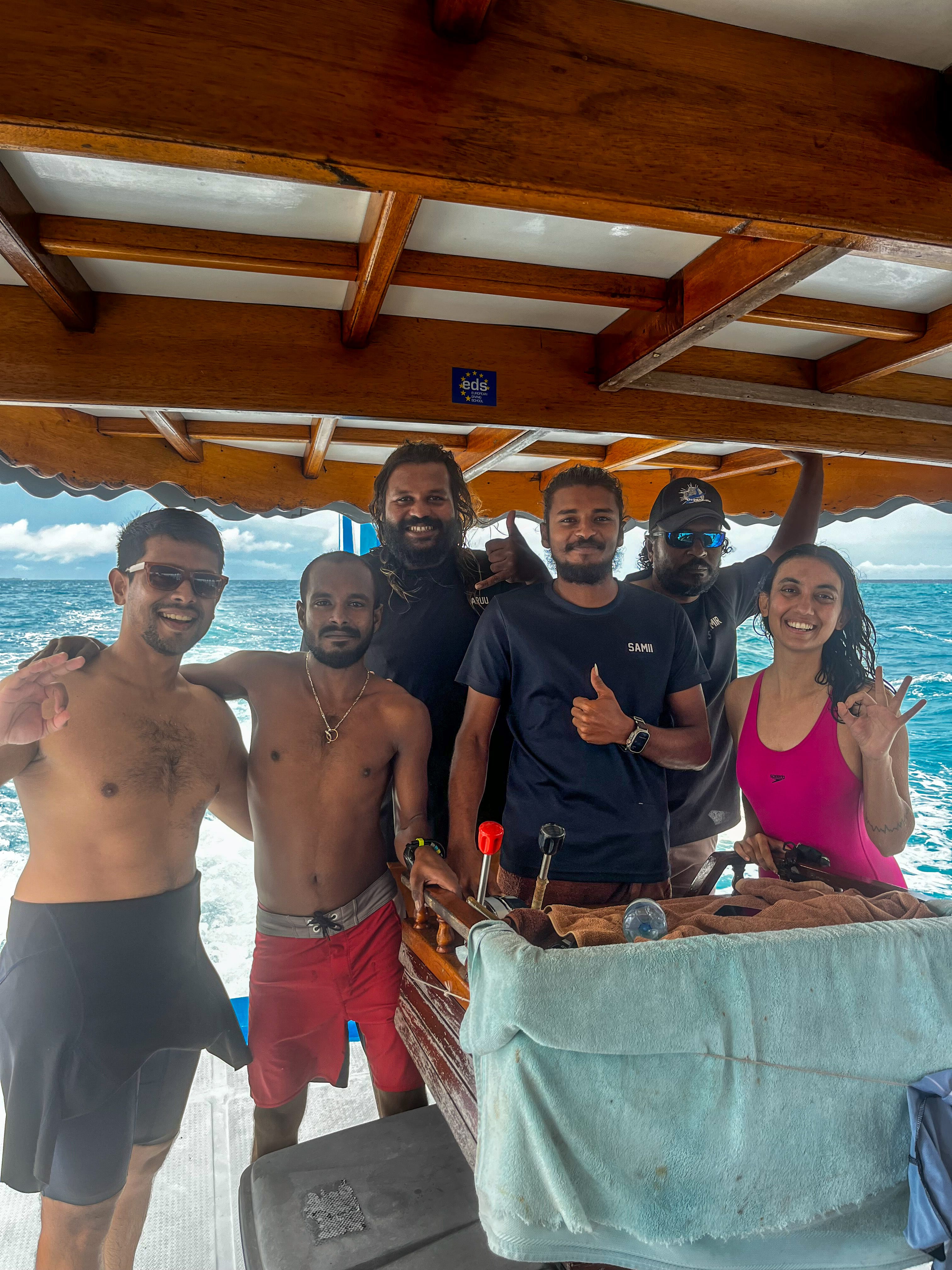
what encounters will we come across today?
After breakfast, you are ushered onto a small truck with your fellow divers for the day. Groggy and packed into the back of a pick-up truck like a can of sardines, you notice how each person is accompanied by equipment that is deeply personal. Vibha with her hot pink face mask and fins, the old Russian man with a weathered diving knife with mysterious origins, the couple on their honeymoon armed with matching rental gear from the local dive shop. We may not understand the languages being spoken on the truck, but we can guess the shared question, what encounters will we come across today?
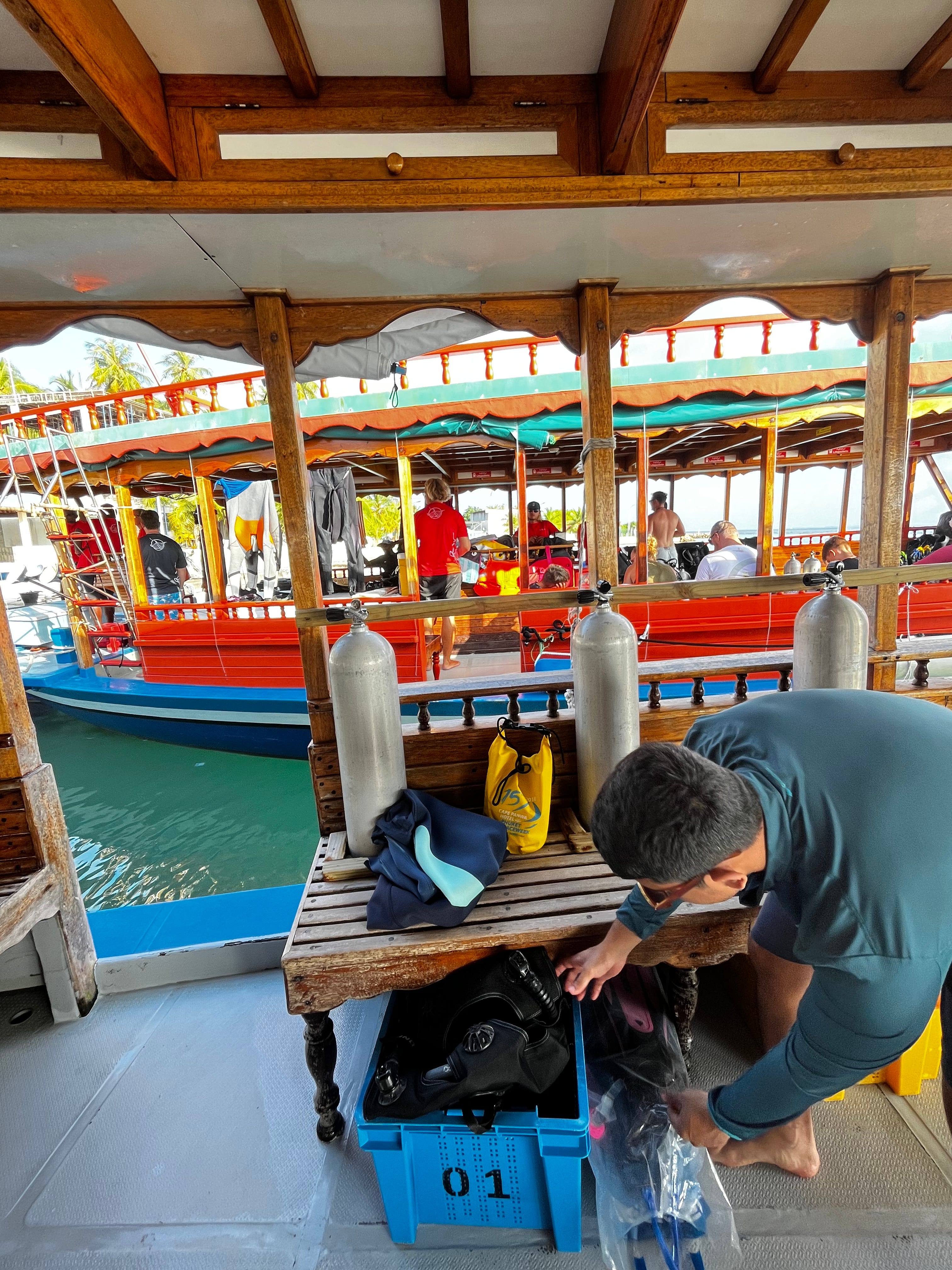
When you reach the harbour, you see the old fishing vessel that has been given a new lease on its life. A Dhoni that was once brimming with nets and harpoons has now been taken over by oxygen cylinders, dive computers, and fins and wetsuits of every size imaginable. Maybe you can teach an old boat new tricks.
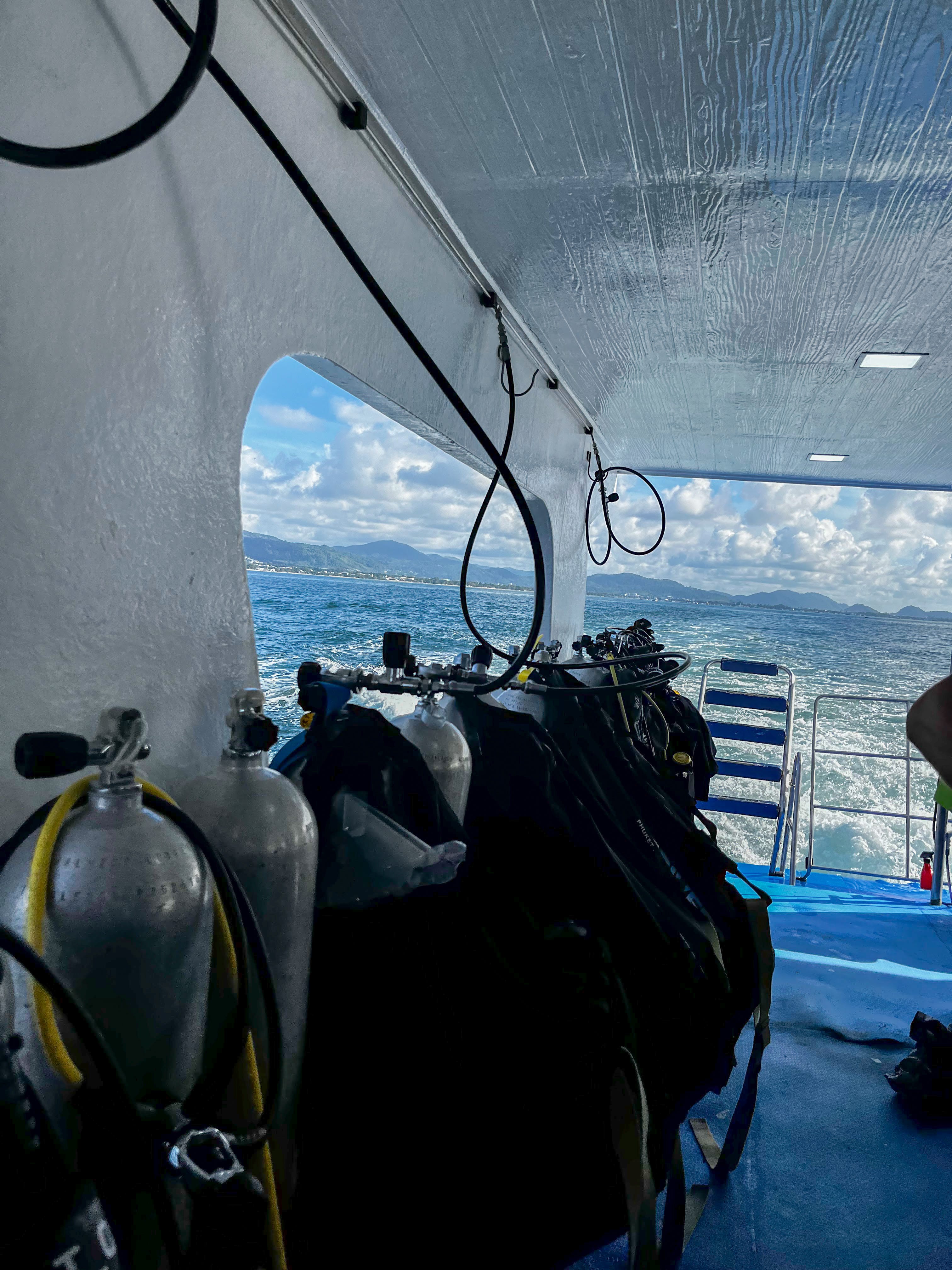
Joseph usually checks out at this point to leave me with the equipment inspection and set-up. I inspect both of our gear, and assemble it by routine, checking the tanks for defects, attaching the buoyancy control device or BCD, and ensuring the regulator is dispensing air properly. As you approach the dive site over choppy waters, the dive master calls everyone to the deck for a briefing on the current, topography, and marine life to watch out for. We disperse after the briefing, back to our own corners of the boat. Some visualise the route. Some catch up on sleep.
As the dive site nears, the calm of the boat ride is interrupted with the call to gear up. BCDs are clipped into, weight belts are fastened, and you will notice people rubbing spit into their face mask before fastening it, a small trick to prevent fogging. We then line up on the now stationary boat. The dive masters lead the charge as the first to jump, with the rest close behind.
Belonging in a Blue World:
The very first plunge with each dive is the same, a trust fall with the deep blue sea. With over 20kgs of clunky equipment on your back, floating is the last thing your mind expects. But counter intuitively, and thanks to a little air you have pumped into your BCD, you rise straight up to the surface of the water, face to face with your dive buddies, ready to descend.
With final looks, you nod to each of your buddies and signal a thumbs down gesture, as you press a button which evacuates your BCD of the air that was keeping you afloat. Together you begin your descent to your diving depth.
This new society includes colourful and bleached corals, a school of thousands of neon yellow goatfish, an eight metre long gentle whale shark, a pair of playful eagle rays, a misunderstood white-tipped reef shark, all living in a relation with one another that our surface-level language has never quite been able to capture.
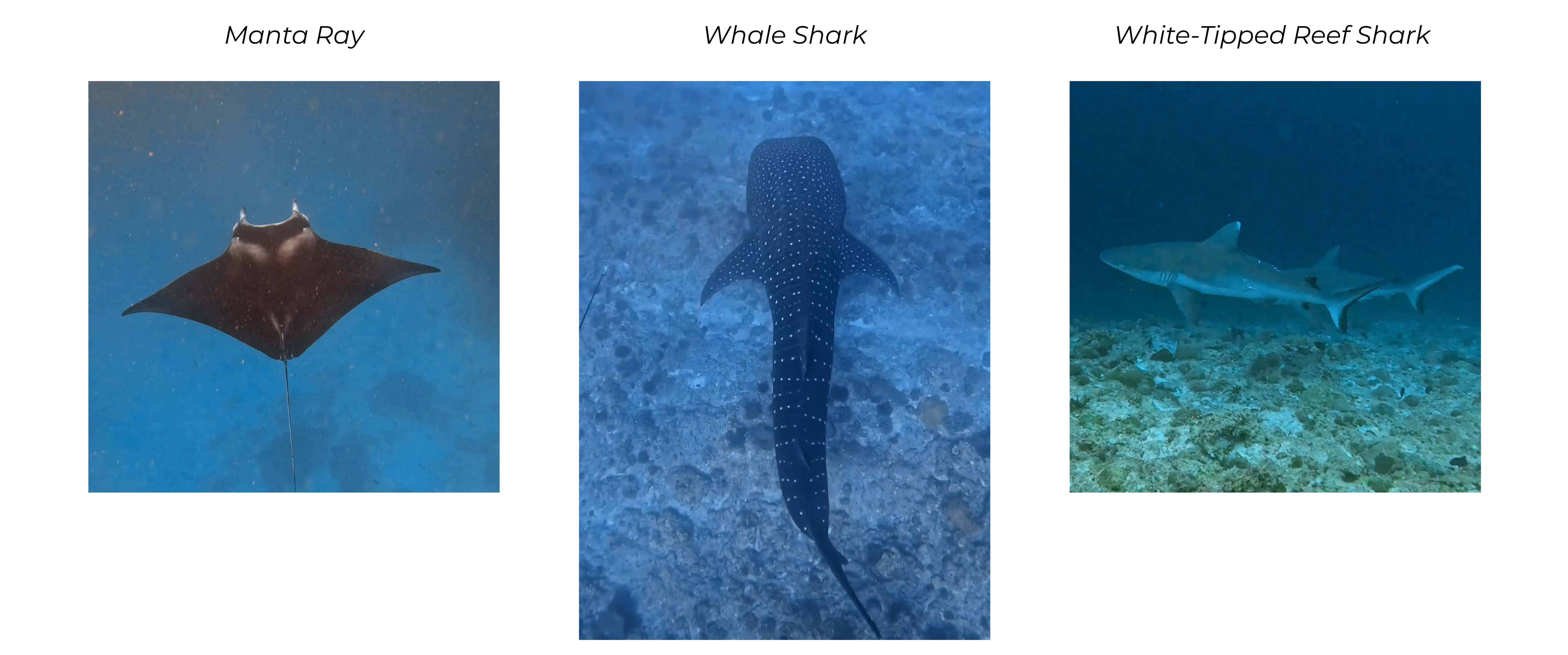
When we use the language of a shark being an apex predator, it carries the connotation of the shark being more important or more valuable than what surrounds it. But between the marine life that you need a magnifying glass to see and the marine life that would need a magnifying glass to see you, a different understanding becomes possible: that belongingness and significance are two sides of the same coin. To belong to a world is already to matter within it, regardless of your size or your place in any hierarchy we have imposed from above. The nudibranchs tucked into the crevices of corals do not ponder the relevance of their existence. The palm-sized remora attached to a manta ray the size of a Maruti Omni does not wish to be larger. The sea turtle keeping company on the top-reef does not concern itself with swimming as fast as the reef sharks nearby. Marine life is secure in its significance. It belongs, and that belonging is enough.
It’s tempting to only engage with what has been constructed to be the apex, but when I stopped looking at the system as a pyramid and started looking at it as a circle, I found my work becoming much richer. And I owe that perspective in part to diving.
So when I scuba dive, I feel larger than life—I feel big. I feel so important knowing that I belong to a world even though the world does not belong to me. Some days I am the nudibranch and some days I am the manta—but on all days, I am significant because I belong. And I don’t just feel this way about myself–I carry this perspective with me on land through my work with OutLawed India. I feel like assuming that people, things, and experiences are significant has allowed me to develop rich relationships with brightspots that I may have otherwise missed.
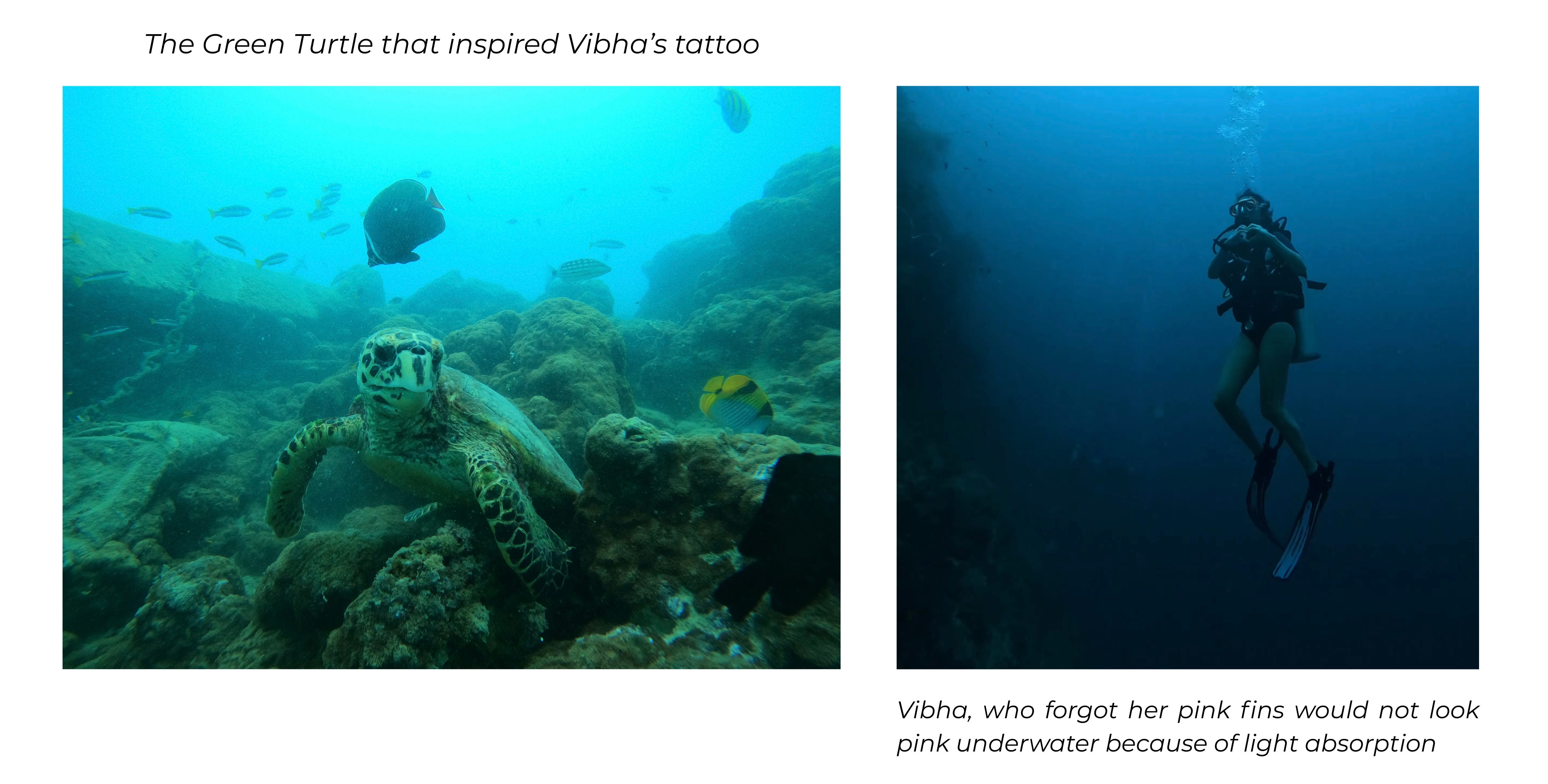
If you are able to get past the voice that is screaming to play by the rules you are used to, then for a short while you come close to what it must be like to explore a new world entirely.
When you work with the law, everything is framed in the language of hierarchies. To solve for access to justice issues in India, we often find ourselves wanting to chase after senior advocates, Supreme Court Judges, and law firm partners. And while this is an important part of the puzzle, I’ve found unexpected behind-the-scenes allies–the PA at a Judges office who has excellent drafting skills, the security guard at Family Court has deep knowledge of court processes, the Paralegal Volunteer in Udupi who retired from the Navy and set up an internet cafe to help people apply for schemes and IDs. It’s tempting to only engage with what has been constructed to be the apex, but when I stopped looking at the system as a pyramid and started looking at it as a circle, I found my work becoming much richer. And I owe that perspective in part to diving.
Joseph has a slight different take on this, but I’ll let him tell you in his own words.
Converse to Vibha’s experiences, diving helps remind me how truly small and insignificant I am. For instance, the whales that I encountered on my dive, at times so close that I had to curtail my urge to reach out and touch them, can grow to ~60 ft in length, and can be as old as 70 years. The whale sharks we encountered float through the ocean like large unencumbered UFOs. The mother and calf sperm whales I dove with, met us with curiosity as opposed to animosity despite our kind’s cruel history with theirs. You see the scars that these gigantic creatures bear across their body from hunting giant squid so deep below the sea that light doesn’t pierce through at those depths. It’s so deep, that humans haven’t been able to capture these hunts on camera.
Time slows as these submarine-like creatures float by you, and you can’t help but feel like it stops altogether when your eyes meet theirs. Very briefly, the transactional world that you live in fades away as you slip into something far more ancient, something far more primal you forgot existed somewhere in the depths of your subconscious.
The mother and calf sperm whales I dove with, met us with curiosity as opposed to animosity despite our kind’s cruel history with theirs.
Sea-ing Things Differently
But having cumulatively done ~100 dives, we’ve also come to realise that the joy of diving prevails even when you’re not 75ft under water. A year ago, we had the privilege of spending a week on a remote island in the Maldives—so remote that it didn’t even have Google Maps. While we were there with the sole intention of diving, the seemingly ancillary parts of our expedition are etched as deeply in our memories as the rest of it— the Sri Lankan chef at our resort who greeted us everyday after our dives, and went out of his way to make vegetarian food. Seeing a mom and dad take turns diving on alternate days so one could stay ashore with their baby—always making sure to be at the pier in time to receive the other as we reached back from our dives. And finally, this otherworldly sunset we saw at the southernmost tip of the island.

Very briefly, the transactional world that you live in fades away as you slip into something far more ancient, something far more primal you forgot existed somewhere in the depths of your subconscious.
We are two lawyers who live in a landlocked city. Our days are spent inside the language of statutes and petitions, in the routines of legal aid and justice delivery, in drafting and closing, in due diligence, and in the slow, often grinding effort of trying to make institutions responsive to people and lives that they were not always designed to see. Diving seems far from that world. Yet we keep returning to what the ocean taught us about attention, about humility, and about belonging. Underwater, constraints are immediate and physical, yet even there you find crevices of abundant life and startling beauty if you learn to notice. You also learn to trust in a literal sense, you trust your buddy, the dive master, the boat crew, and you trust the more-than-human world around you to hold you, to let you pass, and to give you air when you surface. On land, we often behave as if we can manage without that kind of trust, even though we are imbricated with other lives and systems all the time. In the sea, that pretense falls away quickly. These lessons sit beside justice work, and sometimes they strengthen it.

Thanks for sharing this. Love the parallel you drew to the circle in the field of justice- the PAs, the para-legal and security guards.